Specto
SpectoEDUSpectoMEDCompanyContact
Request a demo
Specto
SpectoEDUSpectoMEDCompanyContact
Request a demo

Published research using Specto

Two peer-reviewed neurosurgery studies used Specto software, one for surgical planning and one for informed consent.

VR planning in elective aneurysm surgery

Greuter et al., Frontiers in Surgery (2025). Retrospective cohort of 159 patients and 163 aneurysms.

Paper: Minimally invasive approaches using virtual reality planning in elective aneurysm surgery.

DOI: 10.3389/fsurg.2025.1713243Read the PDF

How the study worked

The study looked back at elective clipping of unruptured intracranial aneurysms at University Hospital Basel from 2009 to 2024. From 2018, the team used VR as standard for planning these operations. The analysis compared cases planned with and without VR.

The paper describes the software as SpectoMedical, CE marked at the time as a Class I medical device, used with an HTC Vive headset. Models were rendered from each patient's preoperative CT angiography or DSA. This setup differs from the current SpectoMED release, which is CE marked as MDR Class IIa and validated on Meta Quest 3.

What the comparison showed

In the published comparison, the approximate 35% and 21% figures are associations: a smaller craniotomy area and a shorter hospital stay. They are not evidence that VR planning caused those differences. Operative time was shorter in the VR group, but the difference was not statistically significant.

35%

Smaller craniotomy

21%

Shorter hospital stay

Limitations the authors report

  • The design was retrospective and not randomized, so the groups may differ in ways the study could not control.
  • VR became standard from 2018, while perioperative care and surgical technology also improved. The shorter stay may partly reflect those changes.
  • Keyhole approaches became more common over the same period, which may explain part of the smaller craniotomy size.
  • There was no systematic intraoperative data, such as clip placement time or the number of clip attempts.
  • More than one surgeon performed the operations.
  • No cosmetic or patient-reported outcomes were collected.
  • Two authors have links to Specto Medical: one is a co-founder and one is a consultant.

Individual outcomes may vary.
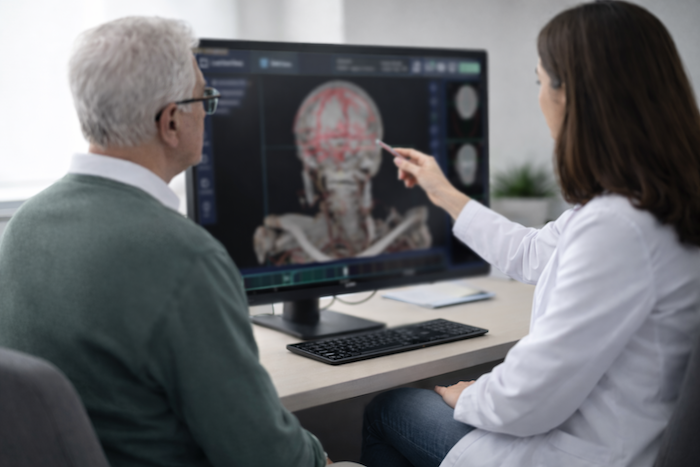
VR for informed consent before neurosurgery

Westarp et al., Acta Neurochirurgica (2024). Single-center pilot study with 10 patients.

Paper: Virtual reality for patient informed consent in skull base tumors and intracranial vascular pathologies: A pilot study.

DOI: 10.1007/s00701-024-06355-w

How the study worked

The study ran at University Hospital Basel from May to December 2023. It included ten adults booked for skull base meningioma resection or aneurysm clipping, and each had the usual written consent first. The surgical team then built a 3D model of each patient's anatomy and pathology in SpectoVR from their preoperative scans.

The day before surgery, the surgeon introduced the model and the VR headset. Each patient then explored their own case in VR while the surgeon explained where the pathology sits, showed a virtual craniotomy and went through the risks and benefits. In aneurysm cases, the surgeon also showed possible clip placements.

What patients reported

After the session, patients rated 18 statements from 1 (strongly disagree) to 5 (strongly agree). The figures below are average ratings, so they show how well patients felt they understood, not what they could recall. All ten completed the study, and side effects such as dizziness were minimal.

4.22

Overall rating of VR consent, out of 5

4.30

Understanding of their pathology, out of 5

3.95

Understanding of the planned procedure, out of 5

3.47

Trust in the surgeon, out of 5

Related pages

VR surgical planning

The headset workflow for studying an approach and measuring in VR.

SpectoMED

The clinical product: clearance, monitor review and planning tools.

Patient education

Patient education

Explaining a patient's CT in 3D during the consultation.

See SpectoMED and SpectoEDU

Tell us whether you are interested in surgical planning or patient education, and we will show you the right one.

Request a demoContact
SpectoEDUSpectoMEDPatient EducationMedical TrainingVR Surgical PlanningResearchSupported HardwareFAQ
Terms & ConditionsPrivacy PolicyImprintContact

© 2026 Specto. All rights reserved.